 Home
Home Software
 AR/Apps
 VR/Meta
 VR SOP
 AI
AI CGI
CGI Partners
 Industries
 About
About Blog
Blog Contact
Air Traffic Control Tower Simulation: Realistic ATC Training for Congested Airspace
Relevant case studies



 Author: Spark Team
Air Traffic Control Tower Simulation: Realistic ATC Training for Congested Airspace
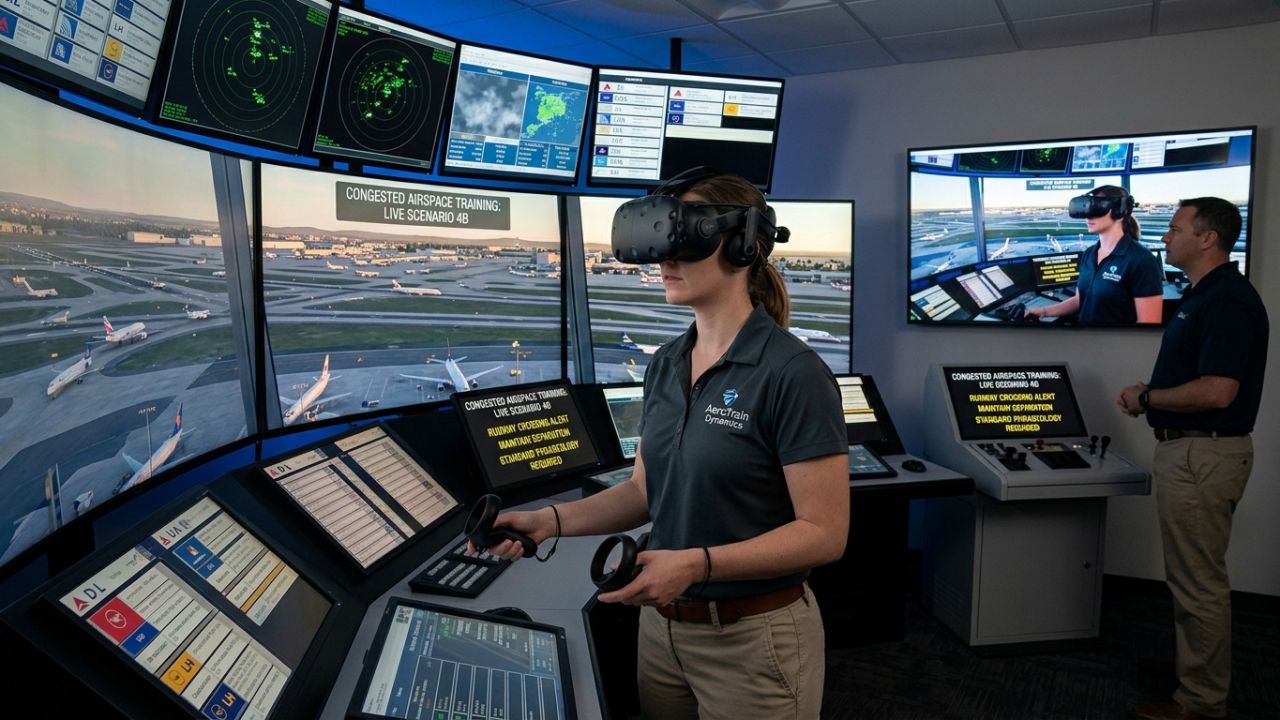
Air traffic control training is built on accuracy, timing and communication under pressure. In congested airspace, controllers must track multiple moving parts, manage runway crossings, maintain separation and use phraseology precisely. Virtual reality and immersive tower simulation can strengthen that training by creating repeatable, high-pressure scenarios that mirror real operational complexity without exposing the live system to risk.
Why ATC training is under pressure
Modern airspace is busy, dynamic and unforgiving. Tower controllers must process visual cues, surveillance data, surface movement, weather, pilot readbacks and coordination demands all at once. Training people to do that well requires much more than memorising phraseology.
The FAA’s Tower Simulation System is specifically designed to train controllers on airport tower operations. According to the FAA, these simulators replicate airport layouts so trainees can practise complex configurations, runway-crossing coordination, phraseology and scenarios that address safety trends. In May 2025, the FAA also said new simulator rollouts were helping trainees learn, develop and practise their skills in a high-tech environment.
That matters because tower simulation is not optional polish. It is central to how complex controller skills are built safely.
Why immersive simulation suits congested-airspace training
Congested airspace is fundamentally a workload-management problem. Controllers need to prioritise, sequence, communicate and recover from developing conflicts before they become serious. VR and immersive tower simulation are powerful here because they allow repeated exposure to rare, difficult or peak-load situations.
A good ATC immersive environment can present:
Multiple inbound and outbound aircraft
Mixed traffic categories and priorities
Runway crossings and intersection departures
Low-visibility operations
Surface vehicle movement
Degraded weather and shifting runway use
Unexpected pilot errors or delayed readbacks
Instructors can then assess not just whether a trainee knows the rule, but whether they apply it accurately under pressure.
Conflict resolution is procedural as well as cognitive
When people think about ATC, they often imagine quick thinking and fast talking. Those matter, but strong control performance also depends on procedural discipline. Phraseology, coordination steps, runway occupancy awareness and timing windows all have to line up.
That is why SOP-led immersive training is so valuable. A bespoke ATC tower solution can be built around:
Local airport layout and traffic pattern
Unit-specific phraseology standards
Peak-hour sequencing scenarios
Runway crossing requests and hold-short compliance
Missed approach and go-around management
Weather deterioration and runway change procedures
Vehicle and aircraft conflict prevention
ICAO’s training framework strongly supports competency-based approaches that focus on performance outcomes and the development of observable capability, which aligns closely with how immersive ATC training is best designed.
Runway safety remains a strong driver
Runway safety is one of the clearest reasons to invest in realistic ATC and surface movement training. The UK CAA says analysis of UK and worldwide data has identified runway incursions and runway excursions as significant issues to UK aviation. The FAA also continues to publish national runway incursion statistics and runway safety resources, underlining the need for ongoing prevention work.
Immersive tower scenarios can be used to rehearse the kinds of events that create risk:
Incorrect runway entry clearance
Late pilot readback correction
Vehicle crossing coordination failure
Reduced visibility surface movement
Simultaneous frequency congestion
Because the training is virtual, instructors can increase difficulty gradually, pause for review, or replay a scenario immediately to reinforce a learning point.
Why immersive tower training can reduce time and cost
ATC training is resource-intensive. It requires instructor time, dedicated systems, carefully staged progression and, in live environments, strict limits around what trainees can do. Immersive tower simulation can reduce pressure on that pipeline by providing more frequent practice opportunities in a controlled setting.
PwC’s broader VR training findings showed that immersive learners completed training faster than classroom learners and that VR becomes increasingly cost-effective as training volume rises. For civil aviation authorities, training academies and large ANSP environments, those economics are relevant. More procedural repetitions can be delivered without equivalent live-system exposure or travel overhead.
Why realism matters more than visuals alone
In ATC, realism is not just about attractive graphics. It is about timing, radio logic, aircraft behaviour, runway geometry and scenario accuracy. A credible immersive tower trainer should reflect the traffic mix, local procedures and conflict patterns trainees are genuinely likely to see.
That means the strongest solutions are usually bespoke. Spark Emerging Technologies can build immersive environments around a specific airport, training syllabus or operational challenge, whether that is a congested civil hub, a military airfield or a mixed-use regional airport.
A bespoke build can include:
Airport-specific visual layouts
Surface movement hotspots
Scenario authoring for local training needs
Instructor controls and performance scoring
Replay, debrief and analytics tools
Communication training benefits from immersion too
One of the biggest advantages of immersive tower simulation is how well it supports communication training. Phraseology errors often seem small on paper, but in real traffic sequences they can create confusion, delay or conflict risk. In VR, trainees experience how quickly those errors compound when aircraft keep moving and new calls continue arriving.
The FAA specifically highlights phraseology practice, runway crossing coordination and complex airport layouts as part of its tower simulation use case. That is exactly the kind of environment where immersive repetition pays off.
Conclusion
Air traffic control training in congested airspace depends on far more than knowledge recall. It demands accurate decisions, strong communication, procedural discipline and composure under pressure. Immersive tower simulation offers a practical way to train those capabilities repeatedly and safely, particularly when the scenarios are built around real operational layouts and real risk patterns.
For aviation organisations looking to strengthen controller readiness, reduce training friction and improve runway-safety preparation, bespoke VR and immersive tower simulation deserve serious attention.
Contact Spark Emerging Technologies to discuss bespoke ATC and aviation VR training
Articles 6–10 can be generated next in the same HTML format, tone and structure.
© 2026 All Rights Reserved | Company Reg No. 05327622 | Spark Emerging Technologies Limited