 Home
Home Software
 AR/Apps
 VR/Meta
 VR SOP
 AI
AI CGI
CGI Partners
 Industries
 About
About Blog
Blog Contact
Surgical Simulation: Laparoscopic (Minimally Invasive) Procedures in Full-Body VR Anatomy
Relevant case studies






 Author: Spark Team
Surgical Simulation: Laparoscopic (Minimally Invasive) Procedures in Full-Body VR Anatomy
Minimally invasive surgery has transformed modern theatre practice, but it has also changed the way clinicians need to train. In laparoscopic procedures such as appendectomy, cholecystectomy, and hysterectomy, the surgeon is no longer relying on direct hand-to-tissue contact in the traditional sense. Instead, they are operating through ports, visualising anatomy on a screen, managing restricted depth perception, and making precise movements with long instruments inside a tightly controlled operative field.
That shift creates a clear training challenge. The operating team needs more than theory. They need repeatable procedural rehearsal, strong anatomical orientation, confident instrument handling, and a reliable way to practise complication response before stepping into a live case. This is where virtual reality training becomes especially valuable for the medical and healthcare sector.
Why laparoscopic SOP training is ideal for VR
Research continues to show that virtual reality is becoming an increasingly effective part of healthcare education, while wider simulation-based practice is recognised for improving team performance, strengthening safety culture, and supporting better patient outcomes. In laparoscopic education specifically, recent evidence highlights that minimally invasive surgery requires intensive training because of the loss of haptic feedback and depth perception, and that VR simulators provide structured, automated feedback that traditional approaches do not always offer as easily.
For hospitals, private surgical centres, medical schools, and device manufacturers, that matters because SOP-based VR training can turn a written process into a measured, repeatable, auditable learning experience.
What this looks like in practice
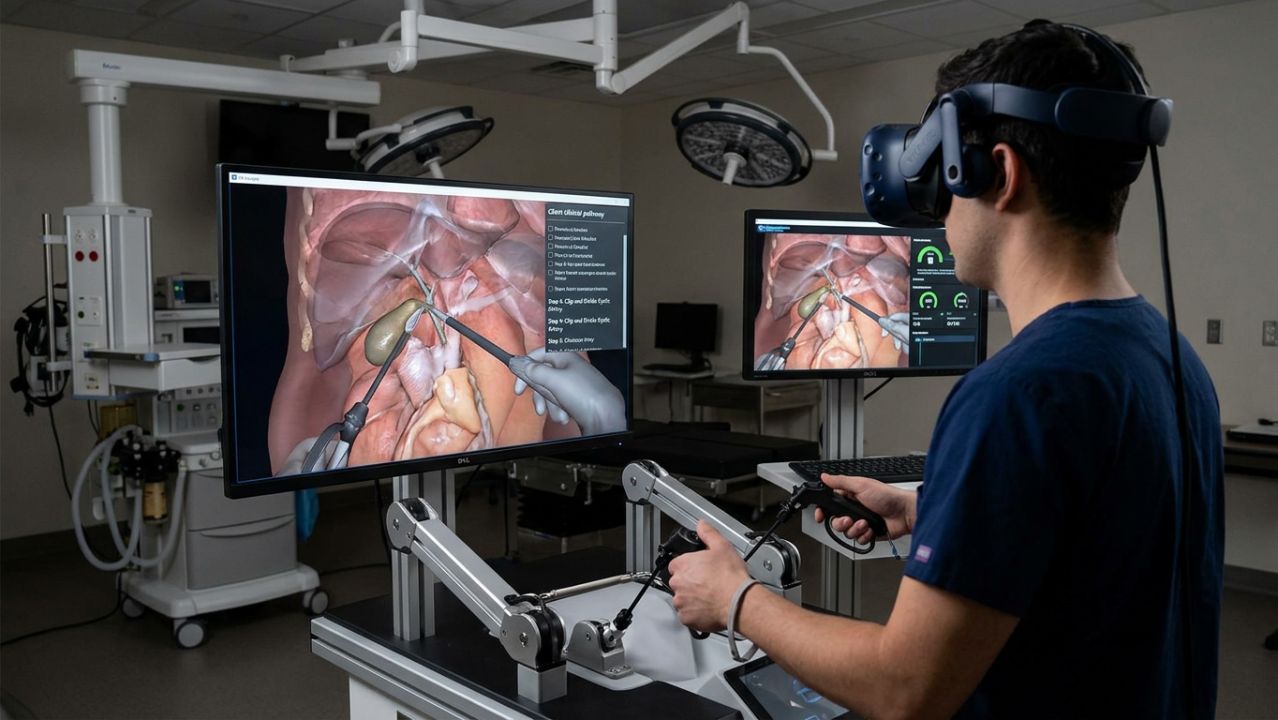
A bespoke Spark VR module for laparoscopic training could place the learner inside a full-body 3D anatomical environment, where they rehearse a procedure step by step against the client’s own clinical pathway, equipment setup, and theatre workflow.
Typical training scenarios may include:
Laparoscopic appendectomy with trocar placement, appendix identification, dissection, ligation, and extraction
Laparoscopic cholecystectomy with critical view of safety checks and bile duct protection
Total laparoscopic hysterectomy with pelvic anatomy familiarisation and bleeding control decision points
Complication branches such as bleeding, poor visualisation, tissue injury, smoke build-up, or instrument failure
Rather than offering a generic demo, Spark’s approach would be to build the simulation around the client’s SOPs, competency frameworks, and certification pathway. That means the training can reflect the real sequence of checks, tool choices, team prompts, and escalation logic expected in the learner’s working environment.
The real advantage is procedural repetition without patient risk
One of the biggest obstacles in surgical training is access. Theatre time is expensive. Consultant supervision is finite. Live-case exposure can be inconsistent. And early-stage learners do not all encounter the same case mix at the same speed.
VR helps address this by allowing repeat practice in a safe setting. A trainee can perform the same stage of a laparoscopic procedure multiple times, receive objective scoring, review where time was lost, and repeat the task until they meet the required standard. That is particularly useful for skills such as camera navigation, clipping, cutting, triangulation, tissue respect, and controlled response to unexpected bleeding.
Key benefits for surgical educators and providers
Standardised training experiences across every learner
Reduced pressure on theatre access for early-stage rehearsal
Measurable performance scoring against SOP criteria
Improved confidence before supervised live exposure
Better consistency across multiple sites or hospital groups
Why cost and time reduction matter so much in healthcare training
Healthcare providers are under constant pressure to improve competence while protecting budgets. VR is attractive because it allows more learners to rehearse more often, without the same dependence on physical training consumables, theatre downtime, or repeated consultant-led demonstrations for every foundational step.
Broader VR learning research from PwC found that learners in VR can complete training up to four times faster than classroom learners, and at larger scale the cost profile becomes more favourable than traditional classroom delivery. While those findings come from enterprise training rather than surgery alone, the underlying lesson is highly relevant to healthcare: immersive learning can compress training time while increasing learner confidence and consistency when used correctly.
What a strong laparoscopic VR module should assess
For medical and healthcare clients, the most valuable VR systems are not just visually impressive. They are measurable. A high-quality module should assess both technical and procedural behaviour.
That can include:
Correct operating room preparation and equipment checks
Port placement logic and safe entry technique
Instrument orientation and economy of movement
Safe dissection around vulnerable structures
Recognition of anatomical variation
Response to intraoperative complications
Completion time and unnecessary motion
Adherence to the required SOP pathway
This is where Spark’s bespoke development model becomes important. Different trusts, hospitals, training bodies, and manufacturers all have different workflows. A fixed off-the-shelf simulation may be useful for general exposure, but it rarely mirrors a site-specific training objective. Spark develops custom VR training experiences so the assessment logic, user journey, visuals, and reporting align with the client’s actual needs.
From skills lab to certification readiness
In many healthcare settings, the goal is not simply to let staff “have a go” in VR. The goal is to support readiness for supervised clinical performance, internal sign-off, and real-world procedural consistency. Because VR environments can track actions, prompts, errors, retries, and decision points, they are well suited to structured progression.
A trainee might start with anatomy familiarisation, move into isolated tool-control drills, then progress to complete procedural walkthroughs, timed assessments, and scenario-based complication management. That journey maps naturally onto modern competency-based education.
Why Spark is well placed to build this
Spark Emerging Technologies creates bespoke VR training systems rather than generic catalogue products. For the medical and healthcare sector, that means training can be designed around real SOP documents, theatre setups, certification frameworks, and stakeholder priorities.
Whether the requirement is a surgical education proof of concept, a multi-module training platform, or a highly specific laparoscopic pathway for one specialty, Spark can shape the experience around measurable outcomes: skill retention, procedural accuracy, confidence, and reduced training overhead.
Conclusion
Laparoscopic surgery demands calm precision, spatial awareness, and disciplined adherence to process. Virtual reality is not a replacement for clinical supervision, but it is a powerful way to prepare clinicians for it. When aligned to SOPs and performance metrics, VR gives surgical teams a practical way to rehearse keyhole procedures more consistently, more safely, and more efficiently.
For organisations looking to modernise surgical education, reduce training bottlenecks, and create a more measurable pathway to competence, bespoke VR training offers a compelling route forward.
To discuss a bespoke medical VR training solution for laparoscopic procedures, contact Spark Emerging Technologies.
© 2026 All Rights Reserved | Company Reg No. 05327622 | Spark Emerging Technologies Limited