 Home
Home Software
 AR/Apps
 VR/Meta
 VR SOP
 AI
AI CGI
CGI Partners
 Industries
 About
About Blog
Blog Contact
Supply Chain and Logistics Coordination: VR Training for Automotive Manufacturing Plants
Relevant case studies




 Author: Spark Team
Supply Chain and Logistics Coordination: VR Training for Automotive Manufacturing Plants
Automotive manufacturing depends on flow. Parts need to arrive in the right quantity, in the right sequence, at the right time, and at the right station. When that flow breaks down, the effect can be immediate: delayed build schedules, line stoppages, premium freight, quality issues, and strained supplier relationships. That is why training for supply chain and logistics teams matters just as much as training for production operators.
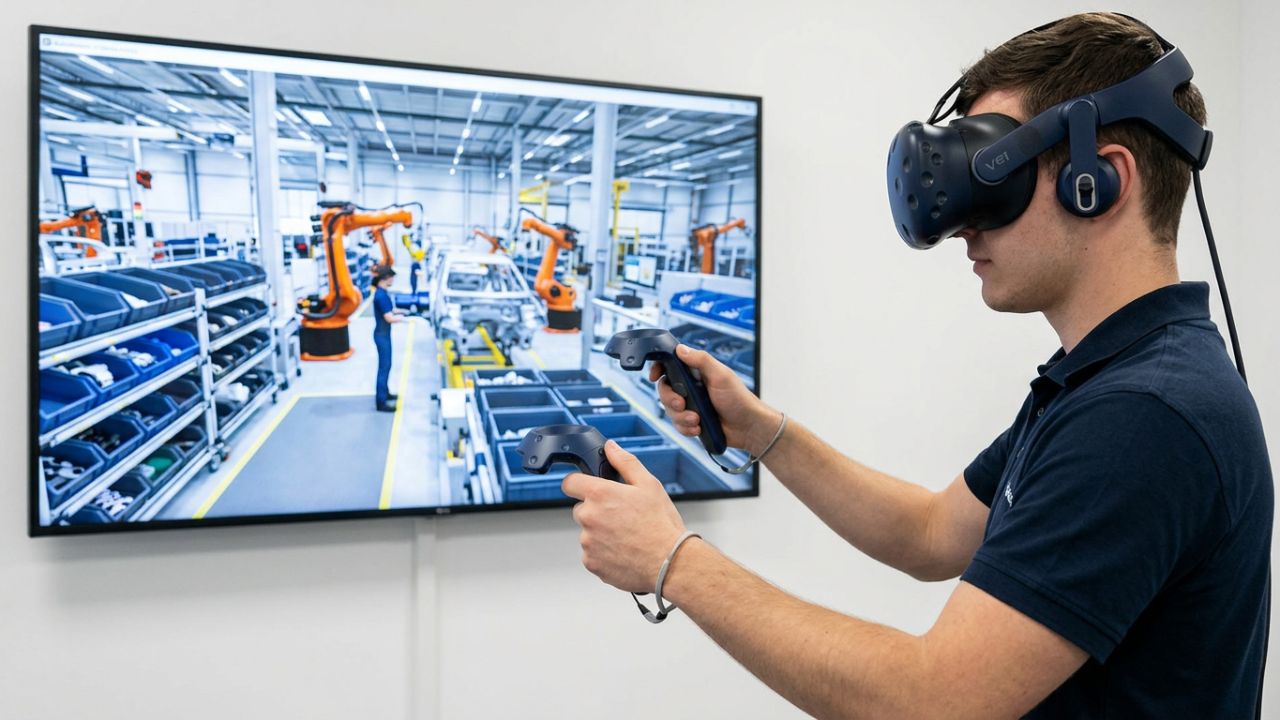
Virtual reality offers a fresh way to prepare logistics and coordination staff for the realities of modern automotive plants. Rather than learning only through documents or spreadsheets, teams can step into a realistic virtual factory environment and practise sequencing, inventory decisions, vendor communication, and response planning in context.
Why logistics training is becoming more important
Automotive supply chains are under pressure from volatility, skills shortages, localisation shifts, and digital complexity. At the same time, the core principle of just-in-time production remains central to efficient automotive operations. That combination means people need stronger procedural training, not less. They must understand how to keep the flow moving while responding calmly and correctly when something changes.
For many manufacturers, this is no longer just about warehouse awareness. It involves coordination across plants, transport, suppliers, sequencing centres, and production teams. The human side of those decisions matters, especially during disruption.
What VR can teach in an automotive logistics setting
VR is useful because supply chain learning is often situational. A trainee needs to understand what good flow looks like, how priorities shift, and what happens when a delay, shortage, or mismatch affects the line. In a virtual plant, those decisions can be made visible.
Typical logistics and coordination tasks suited to VR
- Just-in-time delivery flow and line-feed awareness
- Parts sequencing for variant-heavy production
- Inventory location and replenishment logic
- Supplier communication and escalation workflows
- Cross-functional decision-making during shortages
- Emergency response to delivery failures or stock errors
- Multi-site coordination and transfer process awareness
Instead of treating these as separate topics, VR allows them to be taught as connected operational scenarios. That makes the training more practical and easier to retain.
Why scenario-based logistics training works
In a live plant, the consequences of a poor logistics decision can be immediate and expensive. Yet those high-pressure situations are not always easy to train safely in real time. VR creates an environment where teams can rehearse decision-making without disrupting production.
A trainee might begin with a standard shift handover, review inbound delivery status, identify a sequencing issue, communicate with a supplier, reallocate parts to protect the line, and escalate a risk before it becomes a stoppage. In another scenario, they might handle a late-arriving component that affects multiple build combinations or respond to a stock discrepancy between physical inventory and digital records.
This kind of immersive practice helps teams understand both process and consequence. It is not simply about memorising a rule. It is about knowing how to apply the rule when conditions are changing quickly.
Reducing disruption through better readiness
Supply chain training often relies on job shadowing and practical exposure, but that can create inconsistency. Different supervisors may explain the same process differently, and some disruption scenarios may not happen often enough to train naturally. VR helps by offering a standardised learning environment where the same procedures and response logic can be practised repeatedly.
That can help organisations:
- Standardise logistics training across sites and shifts
- Improve readiness for disruption and shortage events
- Reduce the learning curve for new coordinators and planners
- Strengthen communication between logistics and production teams
- Support continuous improvement in flow-based operations
In a sector built around timing and coordination, those gains can be extremely valuable.
Why bespoke automotive logistics VR matters
Every automotive plant has its own internal flow, supplier network, sequencing rules, part presentation logic, and escalation structure. A generic logistics simulation may help explain broad concepts, but it will not normally reflect the operational detail of a specific OEM or Tier 1 supplier.
Spark Emerging Technologies creates bespoke VR training solutions tailored to the client’s real-world processes. For logistics and supply chain teams, that means training can be built around your plant layout, your line-feed logic, your alert thresholds, your communication flows, and your emergency response process. That is where immersive learning becomes particularly powerful: it mirrors the decisions your teams actually need to make.
The bigger opportunity
Automotive manufacturers are increasingly expected to be both lean and resilient. That balance depends on people who understand the systems around them and can respond effectively when pressure hits. VR training helps build that understanding by showing logistics teams how process, timing, communication, and consequence fit together.
It also allows businesses to teach skills that are often overlooked in traditional logistics training, such as prioritisation under pressure, collaborative problem-solving, and structured escalation. Those skills can make a major difference when supply conditions are tight.
Conclusion
Supply chain and logistics coordination is one of the most important operational disciplines in automotive manufacturing, and it deserves training that reflects the pace and complexity of the real plant. Virtual reality offers a practical, repeatable way to teach just-in-time flow, sequencing, communication, and disruption response in context.
When tied to real SOPs and real plant logic, VR can reduce onboarding friction, improve readiness, and help logistics teams make better decisions under pressure. For modern automotive operations, that makes immersive training a valuable strategic tool.
To explore a bespoke VR training solution for automotive logistics, supply chain coordination, or plant operations, contact Spark Emerging Technologies: https://sparkemtech.co.uk/contact
© 2026 All Rights Reserved | Company Reg No. 05327622 | Spark Emerging Technologies Limited