 Home
Home Software
 AR/Apps
 VR/Meta
 VR SOP
 AI
AI CGI
CGI Partners
 Industries
 About
About Blog
Blog Contact
Radiation Oncology Treatment Planning: Virtual Linac Simulation for Precision Cancer Therapy
Relevant case studies






 Author: Spark Team
Radiation Oncology Treatment Planning: Virtual Linac Simulation for Precision Cancer Therapy
Radiation oncology depends on precision at every stage. From patient positioning and beam setup to dose calculation and organ-at-risk sparing, success relies on disciplined workflows and consistent attention to detail. Even small setup errors can have meaningful consequences, which is why training in this field has always required a strong blend of technical understanding, spatial awareness, and procedural accuracy.
Virtual reality is becoming an increasingly useful way to support that training. For healthcare providers, cancer centres, universities, and equipment teams, VR offers a practical method of translating treatment planning and delivery pathways into immersive learning experiences that can be repeated, assessed, and refined.
Why radiation oncology suits immersive training
Radiotherapy education is not only about learning the theory of treatment. Learners also need to understand spatial relationships between tumour targets, organs at risk, beam pathways, immobilisation, machine workflow, and the real-world steps that sit around safe treatment delivery. That can be difficult to teach using only documents, screen-based presentations, or limited room-based observation.
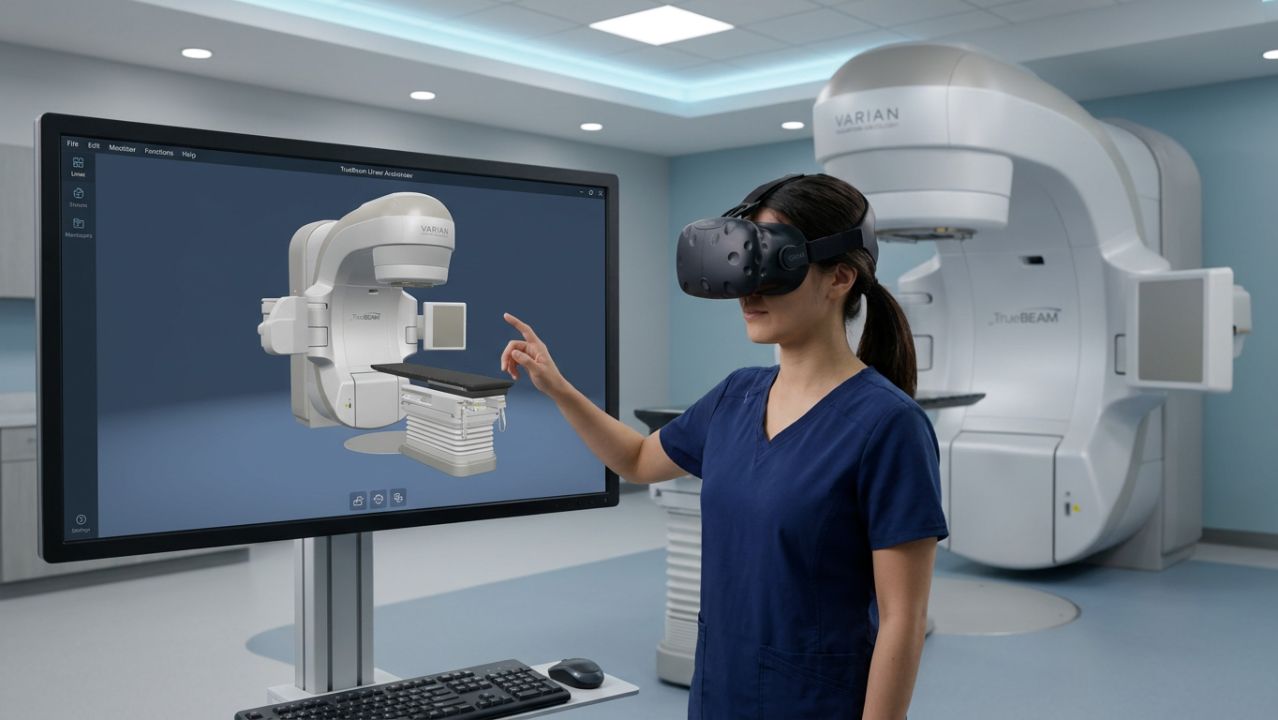
Virtual reality provides a different level of understanding. It allows the learner to step inside a simulated treatment space, see how a virtual linear accelerator behaves around the patient, and understand how setup, field arrangement, and positioning decisions affect the overall pathway.
From SOPs and planning data to an interactive virtual linac
A bespoke radiation oncology VR module could be designed around the client’s own workflow, treatment room layout, planning logic, and training goals. Rather than offering generic visualisation, it can support structured procedural education tied directly to real practice.
Examples of radiation oncology VR training could include:
- Patient positioning and immobilisation checks before treatment
- Virtual linac walkthroughs showing beam paths and gantry movement
- Understanding target volumes and nearby organs at risk in three-dimensional space
- Multi-field coordination and setup sequence rehearsal
- Error prevention scenarios linked to incorrect positioning, incomplete checks, or treatment-room workflow breakdowns
Because Spark creates bespoke solutions, the training can be tailored for radiographers, therapy staff, students, patients, or wider multidisciplinary teams depending on the client’s need. A centre may want staff training, patient education, or both. The value comes from aligning the simulation to the exact objective.
Precision work benefits from spatial understanding
One of the greatest training challenges in radiation oncology is helping learners see the relationship between anatomy, treatment intent, and beam geometry. On a flat screen, this can remain abstract. In VR, it becomes easier to understand how fields intersect, how organs at risk are protected, and why set-up discipline matters so much.
This is especially useful for new staff, students, and anyone being introduced to complex treatment planning concepts. A well-designed VR module can shorten the gap between classroom explanation and confident operational understanding.
Why SOP-driven VR has practical value
Radiation oncology departments rely on exact process. Checklists, setup verification, patient safety steps, and role-specific workflows are all central to safe treatment delivery. VR is useful because it can embed those SOPs into the training itself.
A bespoke module can assess learners on:
- Correct preparation and treatment-room sequence
- Patient positioning and immobilisation checks
- Recognition of setup deviations
- Awareness of beam arrangement and field logic
- Protection of organs at risk through correct planning interpretation
- Workflow discipline and communication during treatment preparation
That means the system can become a measurable learning tool rather than simply a visual demonstration. Supervisors can see whether the learner followed the correct process and where further development is needed.
Reducing time pressure in specialist training
Radiation oncology training often requires access to specialist facilities, supervision time, and carefully controlled teaching moments. VR cannot replace real-world clinical exposure, but it can make early-stage learning more efficient by allowing learners to build familiarity before stepping into the live environment.
That can help reduce the pressure on treatment rooms and teaching staff while improving learner confidence and preparedness. It also makes refresher training easier to repeat, particularly for procedural pathways that require strong consistency.
Beyond staff training: patient understanding and reassurance
Virtual reality has another potential benefit in radiation oncology: patient education. The ability to visualise the treatment room, machine movement, and beam concept in an understandable way can reduce uncertainty and improve comprehension before treatment begins. For some centres, this could form part of a wider education and reassurance pathway alongside staff development.
That flexibility is part of what makes VR so attractive in oncology settings. The same core environment can be adapted for different audiences and different communication needs.
Why Spark adds value
Spark Emerging Technologies develops bespoke VR training systems designed around operational reality. In radiation oncology, that means training can be mapped to real treatment workflows, local protocols, room layouts, and performance expectations. Whether the objective is staff education, patient preparation, or a combined platform, Spark can develop a tailored experience that reflects the client’s exact environment.
That bespoke model is especially important in specialist healthcare settings where nuance matters and generic off-the-shelf training often falls short.
Conclusion
Radiation oncology is a field where precision, process, and spatial understanding all come together. Virtual reality offers a powerful way to support that by helping learners visualise complex treatment pathways, rehearse SOPs, and build confidence in a safe digital setting.
For organisations looking to improve oncology education, enhance consistency, and make specialist training more accessible, bespoke VR can be a highly effective solution.
To discuss a bespoke VR solution for radiation oncology training, contact Spark Emerging Technologies.
© 2026 All Rights Reserved | Company Reg No. 05327622 | Spark Emerging Technologies Limited