 Home
Home Software
 AR/Apps
 VR/Meta
 VR SOP
 AI
AI CGI
CGI Partners
 Industries
 About
About Blog
Blog Contact
Helicopter Emergency Autorotation Training in Virtual Reality
Relevant case studies






 Author: Spark Team
Helicopter Emergency Autorotation Training in Virtual Reality
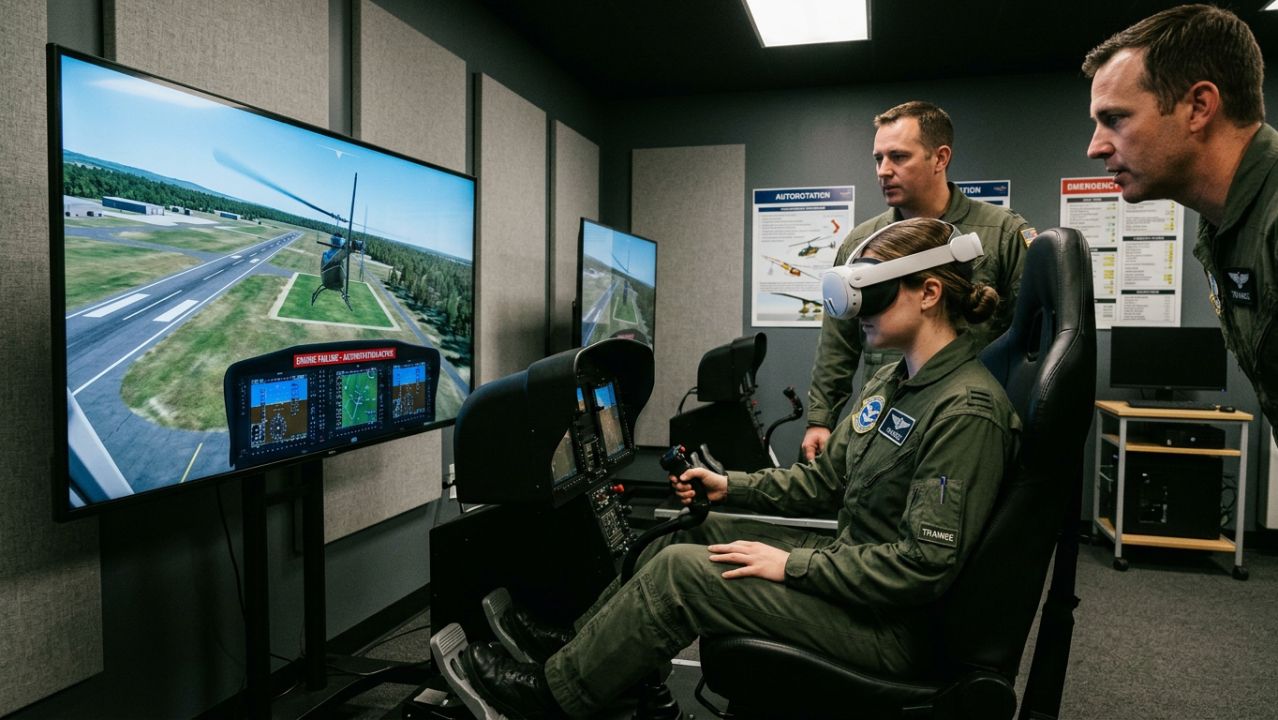
Autorotation is one of the most critical skills in rotary aviation, and one of the hardest to practise confidently. Virtual reality cannot replace live instruction or approved flight devices, but it can provide a powerful preparation layer for engine-failure recognition, emergency sequence rehearsal and landing decision-making. For helicopter operators, that means safer repetition, better readiness and more efficient use of premium training time.
Why autorotation training remains so demanding
Few helicopter procedures carry the same psychological pressure as autorotation. It is time-critical, physically dynamic and unforgiving of delayed response. The pilot must recognise the failure, preserve rotor RPM, control airspeed, choose a landing area and manage the flare and touchdown sequence, often within seconds.
The FAA’s Helicopter Flying Handbook explains that autorotation is a power-off manoeuvre in which the engine is disengaged from the rotor system and the rotor blades are driven by upward airflow through the rotor. The FAA also notes that pilots should experience autorotations from various airspeeds to better understand the control inputs needed to achieve the desired performance.
That is exactly why immersive rehearsal has value. Even before a pilot enters a live training phase, VR can help build mental sequencing, visual scan discipline and procedural confidence.
What VR can realistically train in rotary emergencies
VR is especially strong when the goal is to rehearse perception, sequence and decision-making. In autorotation training, that includes:
Engine-failure recognition cues
Immediate lowering of collective
Rotor RPM protection
Airspeed and attitude management
Landing site selection
Final flare timing awareness
Crew communication and emergency call-outs
It also gives instructors a way to present multiple environments without airborne risk: offshore platforms, urban rooftops, confined areas, slopes, dust, night conditions or degraded visibility.
From lift-off to landing: why the whole sequence matters
Emergency training in helicopters should not start at the point of failure alone. The most useful immersive scenarios begin earlier, showing how the emergency develops and how the pilot’s workload changes from lift-off through to landing.
A procedural VR module might include:
Pre-take-off emergency briefing
Hover or departure phase monitoring
Engine-loss cue onset
Immediate control response
Selection of best landing direction and site
Decision on whether to turn, continue or cushion ahead
Flare and touchdown sequence
Post-landing actions and shutdown logic
This approach is especially useful for operators who want pilots to rehearse not just the textbook manoeuvre, but the operational decision chain around it.
Why VR improves preparation before costly live training
Autorotation is a high-value use case because live training is expensive, safety-sensitive and not unlimited. Every additional airborne repetition has cost, risk and scheduling implications. A bespoke VR layer can move the early part of that learning curve into a controlled environment.
That does not eliminate the need for aircraft or approved device training. What it can do is make the pilot better prepared before those sessions begin. By the time the trainee meets the instructor in the aircraft or simulator, the emergency sequence is already more familiar, reducing cognitive overload and making the live session more productive.
Wider immersive-learning evidence supports this efficiency argument. PwC found that VR learners completed training significantly faster than classroom learners and showed materially higher confidence in applying what they had learned. In a helicopter emergency context, that combination of repetition and confidence is highly valuable.
Rehearsing the decisions pilots actually struggle with
The challenge in autorotation training is not only the control movement. It is the judgement wrapped around it. Which site is genuinely reachable? Is a turn appropriate? How will wind, slope, obstacles or surface texture change the choice? What if the emergency happens immediately after take-off? What if the landing area is visually available but tactically poor?
VR can present these judgement moments repeatedly, with scoring against SOPs or operational best practice. That makes it useful not just for ab initio rotary training, but also for recurrent training and operator-specific emergency refreshers.
Different helicopter operations need different scenarios
One of the biggest mistakes in emergency training design is assuming that all helicopter operations face the same challenges. They do not. Offshore transport, HEMS, police aviation, utility work, military operations and executive transport all create different emergency decision environments.
A bespoke VR system can therefore be tailored to:
Aircraft type and cockpit layout
Single-pilot or multi-crew operation
Local terrain and known hazard environments
Operator SOPs and emergency check philosophy
Typical mission profiles and take-off/landing sites
That is where Spark’s bespoke approach matters. Rather than offering a generic helicopter demo, Spark can build around the operator’s procedures, geography and mission exposure.
Industry momentum is already visible
The helicopter training market is already embracing more immersive methods. Leonardo has described virtual cockpit familiarisation tools as cost-effective ways for pilots to learn normal and emergency procedures, while Loft Dynamics announced in 2025 that Airbus Helicopters had become the first OEM to receive regulatory approval to deliver a pilot type-rating programme using a VR flight simulator. These developments show that immersive rotary training is moving steadily closer to mainstream operational use.
What a strong rotary VR module should contain
For helicopter emergency training, quality matters. A serious module should include:
Aircraft-specific cockpit controls and layout
Faithful visual cues for rotor and engine events
Branching scenario logic based on pilot decisions
Environment-specific landing choices
Instructor review and replay options
Scoring based on timing, sequence and procedure
Recurrent training analytics over time
When this is tied to the operator’s SOPs and emergency doctrine, the value becomes much greater than a visual experience. It becomes a decision-training tool.
Conclusion
Autorotation is one of the most important skills in rotary aviation, and one of the hardest to build through occasional exposure alone. Virtual reality offers helicopter operators a practical way to improve readiness before live training, repeat critical decisions more often, and embed emergency SOPs in a more memorable way.
For operators looking to improve rotary emergency preparation, the future is not generic simulation. It is bespoke, scenario-led training that reflects the real decisions pilots may one day face.
Contact Spark to discuss bespoke VR helicopter emergency training
© 2026 All Rights Reserved | Company Reg No. 05327622 | Spark Emerging Technologies Limited